
FLIGHT SCIENCE · 6 min read
Eight One-Speed Discs, One Field Test: What the Landing Data Showed
The speed number stayed at one. The glide and fade numbers changed—and the measured landing points showed why one-speed discs can fill very different jobs.
How the field test was run
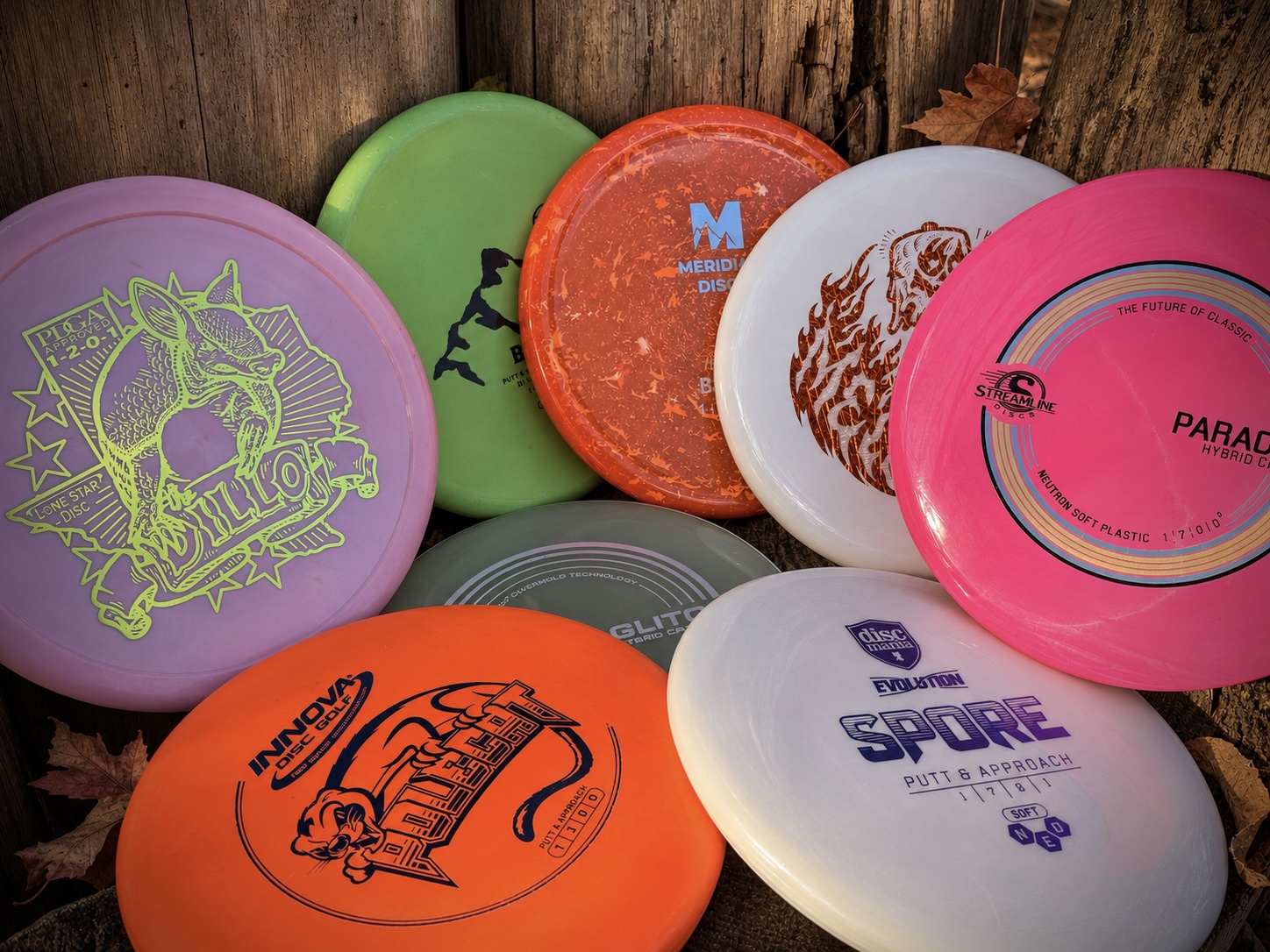
Eight one-speed molds were thrown from the same release area: the Discmania Spore, Streamline Parachute, Lone Star Armadillo, Meridian Mellow, Kastaplast Berg, MVP Glitch, Innova Butte and Innova Polecat.
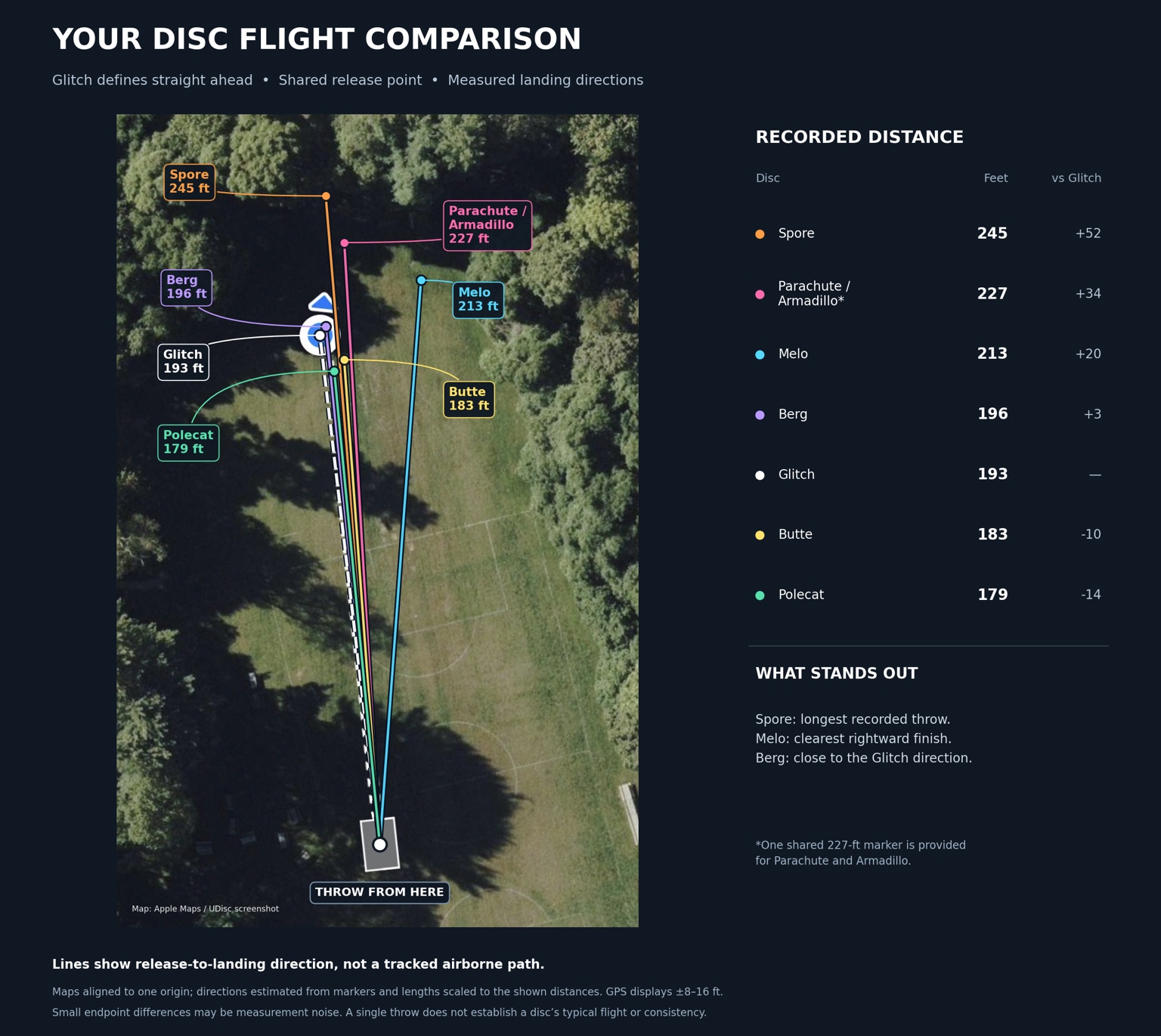
The Glitch line was used as the straight-ahead reference. Each marked endpoint was measured from the shared release area and aligned to that direction.
The colored lines connect the release point to the landing markers; they show release-to-landing bearings, not the discs' airborne paths.
This was a single-session observational test, not a controlled laboratory trial. Wind, release angle, nose angle, height and GPS error can affect an individual throw.
Because the UDisc display was limited by roughly 8 to 16 feet of GPS precision, close results should be read as clusters rather than exact rankings.
Measured results
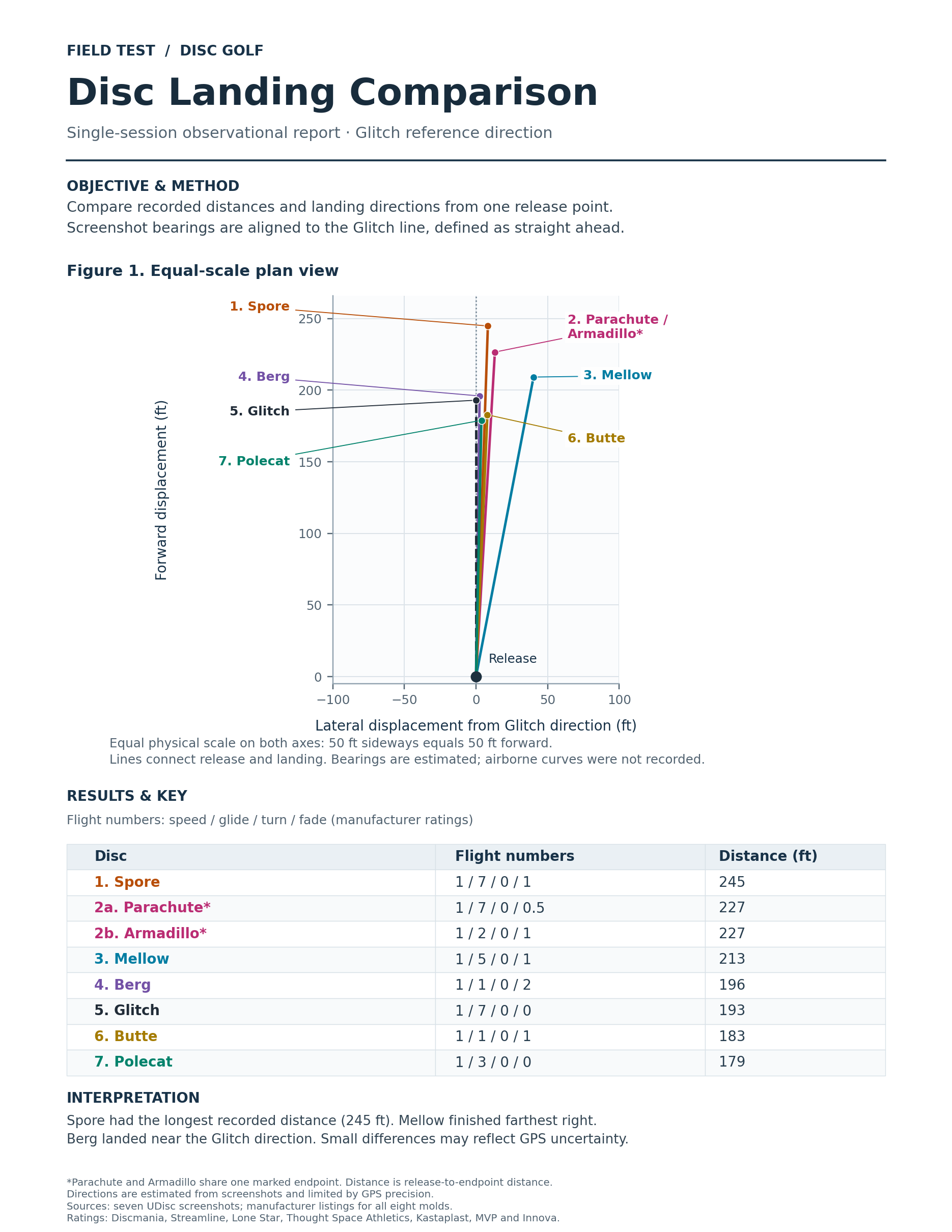
The table and complete report preserve the recorded measurements, manufacturer flight numbers and comparison with the 193-foot Glitch reference. Parachute and Armadillo share one marked 227-foot endpoint.
| Disc | Flight numbers | Distance | Vs. Glitch |
|---|---|---|---|
| Discmania Spore | 1 / 7 / 0 / 1 | 245 ft | +52 ft |
| Streamline Parachute | 1 / 7 / 0 / 0.5 | 227 ft | +34 ft |
| Lone Star Armadillo | 1 / 2 / 0 / 1 | 227 ft | +34 ft |
| Meridian Mellow | 1 / 5 / 0 / 1 | 213 ft | +20 ft |
| Kastaplast Berg | 1 / 1 / 0 / 2 | 196 ft | +3 ft |
| MVP Glitch | 1 / 7 / 0 / 0 | 193 ft | Reference |
| Innova Butte | 1 / 1 / 0 / 1 | 183 ft | -10 ft |
| Innova Polecat | 1 / 3 / 0 / 0 | 179 ft | -14 ft |
What the results suggest
The Spore produced the longest recorded throw at 245 feet while staying close to the reference direction. The Mellow reached 213 feet and finished farthest right. The Berg landed near the Glitch direction and only three feet farther forward.
Parachute and Armadillo reached the same 227-foot endpoint despite very different listed glide. The seven-glide Glitch also finished behind the one-glide Berg.
Those results do not mean the discs flew the same; they show that a landing point and printed flight numbers cannot describe the full shape, speed retention or consistency of a throw.
The conclusion should remain narrow: these are the measurements from one field session. Repeated throws, alternating the throwing order and recording wind and release speed would create a stronger picture of each mold's typical flight.
Flight numbers are a useful starting description, but the best disc is the one that repeatedly performs the job a player's course requires.
Watch the field test
The short video adds the field context that a table cannot show. Watch the releases and compare the measured landing results with the printed flight numbers, but remember that the marked lines represent release-to-landing direction rather than the discs' full airborne paths.
How to use these results
Choose a speed-one disc by the job you need near the basket or on a short tee. The Spore is the carry result to investigate from this session, the Mellow shows the most distinct lateral finish, and the Berg, Butte and Polecat group demonstrates how speed one can limit forward push.
Test any choice at your own power with several throws on the same line. Record the safe miss and how quickly the disc settles after landing.
One distance measurement does not choose a winner; repeatable flight and landing behavior determine whether a disc earns a place in the bag.
Compare exact photos, price, condition and flight numbers in the live inventory—or join the Flight List for new drops and field notes.