
COURSE SPOTLIGHT · 8 min read
Massachusetts Course Spotlight: How to Plan a Round at Mile Marker 63
A former ball-golf property, an organic farm and a modern Simon Lizotte–Casey White design create a course where landing zones matter as much as raw distance.
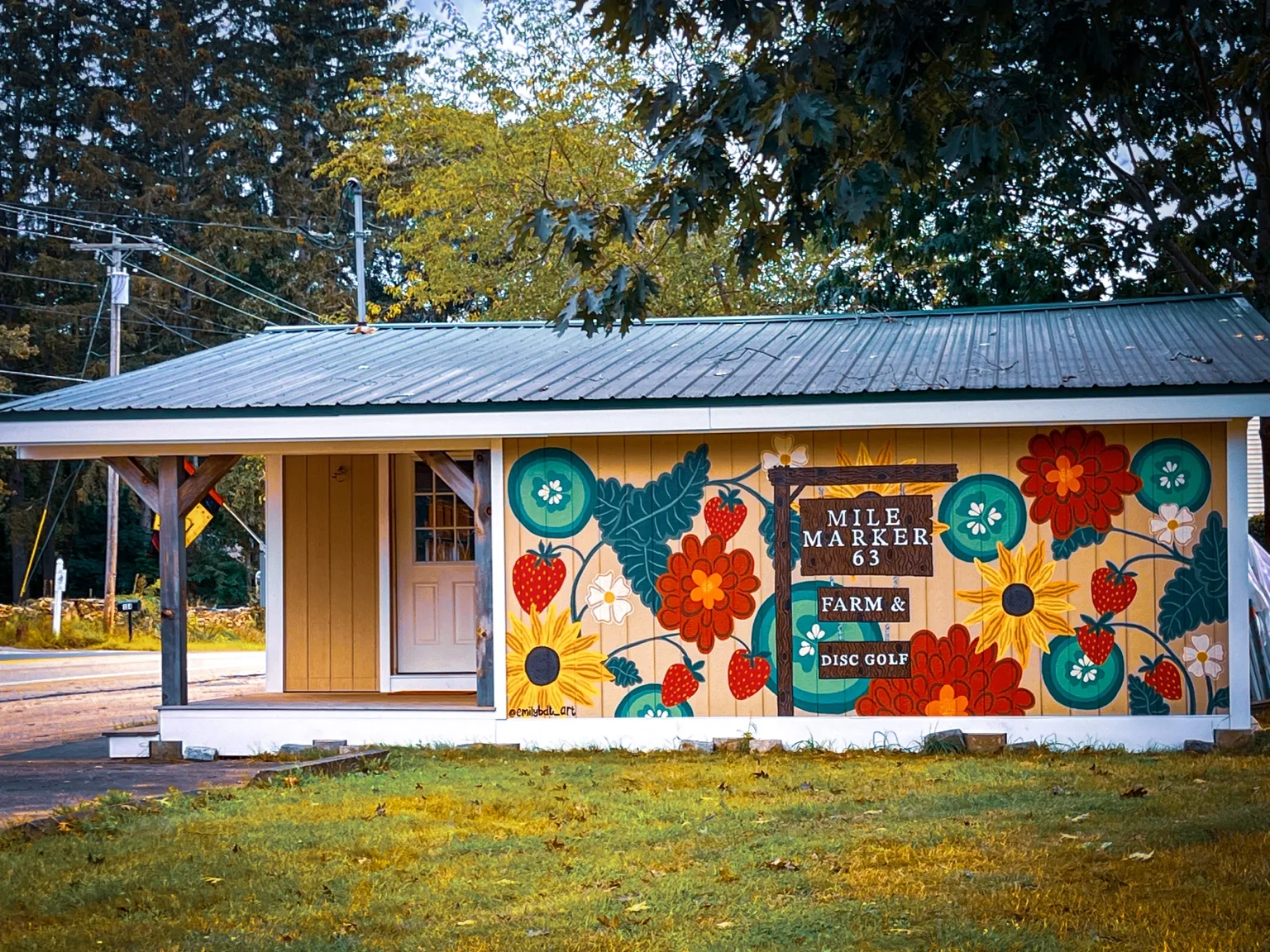
A young course with a clear identity
Mile Marker 63 opened in East Brookfield, Massachusetts, in 2024 on a former nine-hole ball-golf property that is now part organic farm and part disc golf destination.
The 18-hole course was designed by Simon Lizotte and Casey White, and its mix of rolling terrain, open landing zones, water, fences and mandatory routes makes it feel different from a traditional New England woods course.
The setting creates room to throw, but it does not remove decision-making. Long holes ask players to place the first shot so the next one has a clean angle.
Out-of-bounds lines turn a wide fairway into a narrower scoring lane, and the wind can make a comfortable driver behave like a completely different disc.
This is a pay-to-play private property with a check-in process and changing hours or event restrictions. Confirm the current schedule and access details before driving, especially outside peak season.
The scoring plan starts with the landing zone
On an open property, it is tempting to treat every tee as a distance contest. A better plan is to work backward from the green. Identify which side gives the cleanest approach, then choose the driver that reaches that landing zone without bringing the boundary into play.
A controlled fairway may create a better birdie chance than a maximum-distance shot that finishes pinched against a fence or tree line.
Longer players can attack more aggressively, but the course still asks for shape. A stable fairway on a sweeping hyzer, a neutral driver that holds flat and an overstable option for the headwind cover most of the major tee-shot questions.
The approach disc should be boring in the best way: predictable, low-skip and comfortable from a standstill.
The UDisc listing identifies both short and long concepts, with the short layout still stretching beyond 6,000 feet. That makes pace and energy management part of the round.
Carry water, give faster groups room and avoid turning early holes into a power test that drains the second half.
What to pack
Bring one neutral-to-stable fairway driver for placement, one distance driver you trust in a headwind and one slower disc that lands softly near guarded baskets.
Players who prefer forehands should also carry an approach disc that can handle torque without producing an exaggerated skip.
Footing is generally friendlier than a rocky woods course, yet weather can still change the property quickly. Pack a towel, a backup grip option and a brighter disc for long grass or changing light.
The best round here is not the one with the most heroic throws; it is the one with the fewest self-created recovery shots.
Compare exact photos, price, condition and flight numbers in the live inventory—or join the Flight List for new drops and field notes.