
DISC FLIGHT DYNAMICS · 3 min read
Innova Jay Flight Dynamics: Why 5 | 4 | 0 | 1 Flies So Straight
The Innova Jay is a torque-resistant, point-and-shoot midrange built to hold its starting line before a gentle forward finish.
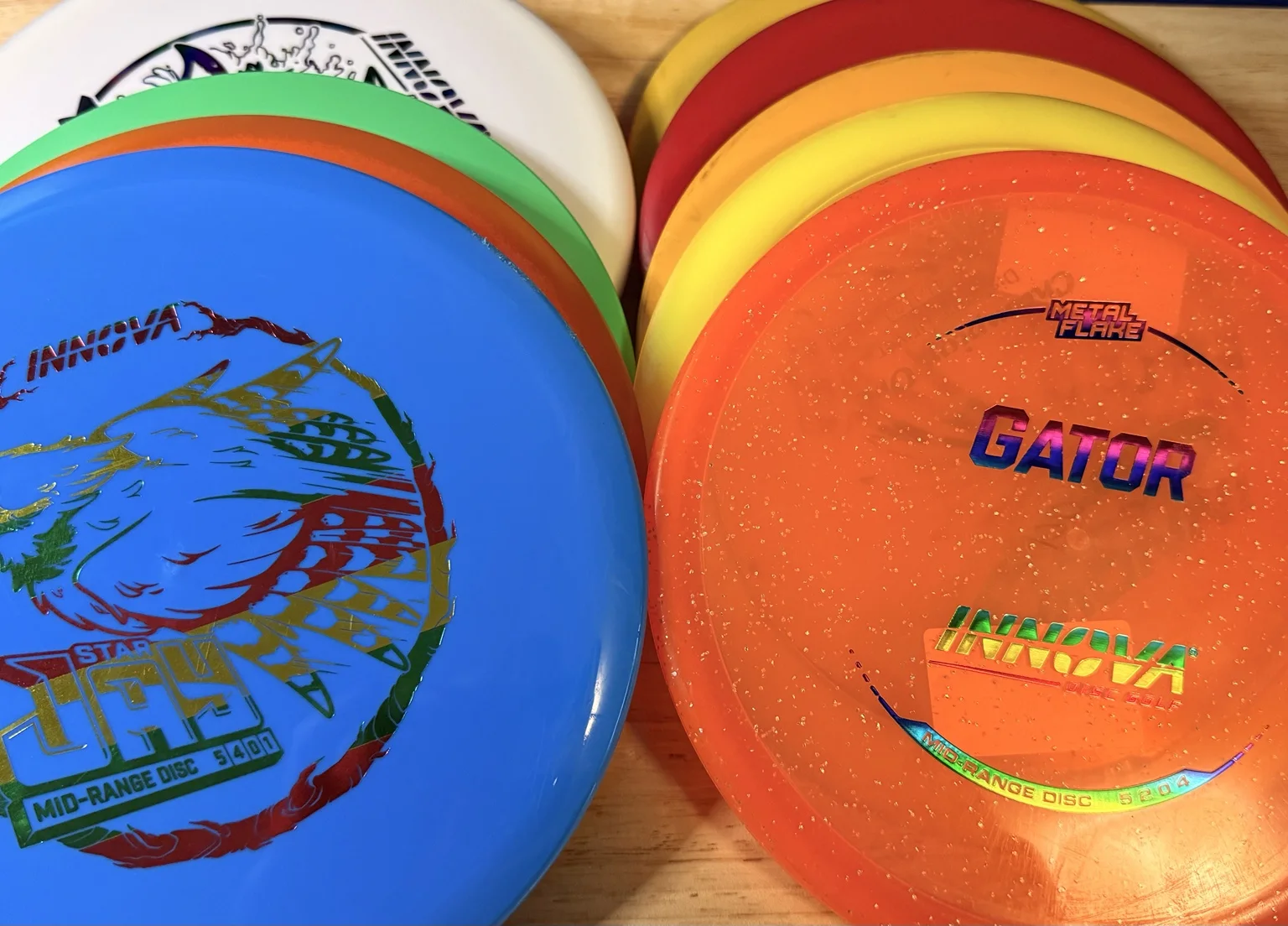
What 5 | 4 | 0 | 1 is trying to describe
Speed 5 places the Jay in the traditional midrange class: fast enough to cover controlled tee shots, but slow enough to land with less skip than a fairway driver. Glide 4 gives it useful carry without making it unusually floaty.
Turn 0 suggests that a clean, flat release should resist drifting right for a right-handed backhand thrower. Fade 1 describes a mild finish as the disc slows.
Those numbers describe an intended flight, not a guarantee. Weight, plastic, wear, wind, nose angle and arm speed all matter.
Innova describes the Jay as able to handle power while still finishing straight, which is why it fits between a very neutral midrange and a more overstable utility mid.
For a player throwing roughly 230 to 280 feet, the Jay should usually show its straight character without demanding maximum effort.
At lower power it may finish earlier. At higher power or with a seasoned copy, it may carry straighter for longer before the fade appears.
| Number | Flight job | What to watch |
|---|---|---|
| 5 speed | Controlled midrange distance | Too much nose-up angle shortens the flight |
| 4 glide | Steady carry without excessive float | Height still changes the landing point |
| 0 turn | Resists unwanted right drift | Off-axis torque can still force movement |
| 1 fade | Gentle forward finish | A headwind can reduce that margin |
The most useful Jay lines
Thrown flat, the Jay is designed for straight tunnel shots, placement drives and approaches where a large finish would move the disc away from the target.
A small hyzer can create a dependable push that stays on the hyzer instead of flipping aggressively. On a controlled anhyzer, the disc can pan without immediately fighting out, but it is not meant to replace a truly understable midrange.
The Jay also rewards smooth standstills. Because it does not need a dramatic flip to reach center, it is useful when the footing is poor or the fairway asks for accuracy before distance.
The low-speed fade is mild enough to keep many misses close instead of creating a long skip.
The common mistake is trying to manufacture extra distance by overpowering it. If the disc wobbles or burns right, check grip pressure, wrist alignment and nose angle before deciding the mold is understable. A clean midrange release should show the Jay's intended stability.
A simple field test
Throw three flat shots at 70 to 80 percent power, then three on a small hyzer. Record where the disc first moves away from the release line and where it lands.
Repeat into a light headwind and tailwind. The goal is not maximum distance; it is learning the release that produces the smallest sideways movement.
Compare the Jay with one understable midrange and one overstable midrange. If the Jay consistently lands between them, it is doing its workhorse job.
If it overlaps another disc exactly, choose the one that feels better or lands more predictably rather than carrying both without a purpose.
Compare exact photos, price, condition and flight numbers in the live inventory—or join the Flight List for new drops and field notes.