
CENTRAL U.S. COURSE SPOTLIGHT · 8 min read
Central U.S. Course Spotlight: A Smart First Round at Eagles Crossing
Eagles Crossing delivers the scale and presentation of a destination golf property, but the right tees and conservative landing zones make the experience more than a distance contest.
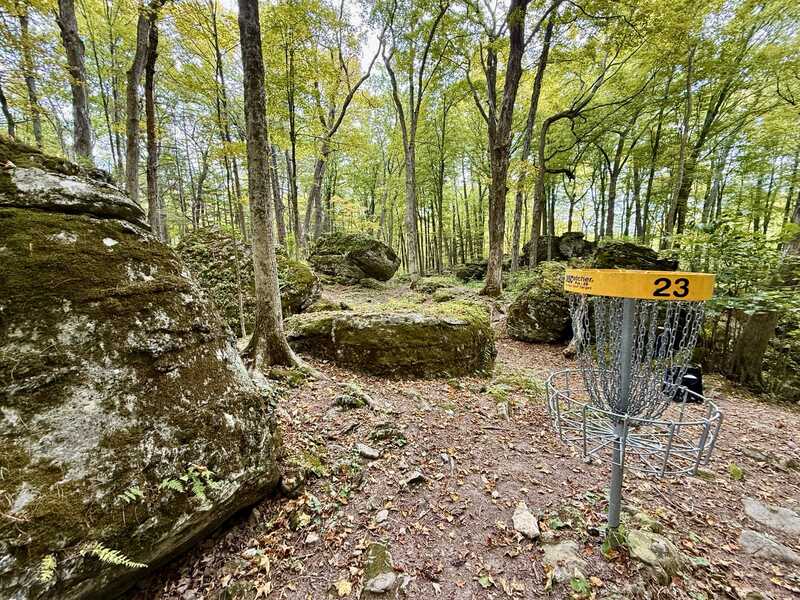
A destination built around the complete experience
Eagles Crossing is in Hawk Point, Missouri, about an hour west of St. Louis Lambert International Airport.
The property spans more than 400 acres and currently offers the Championship Course and Wild Times, along with a driving range, pro shop, cart rentals and on-site cabins.
The Championship Course is an 18-hole, par-70 layout. The official site lists it at 11,556 feet, while the PDGA directory lists the active course at 11,328 feet with an alternate length of 11,696.
Those differences reflect layouts and pin positions, but every number points to the same truth: this is long, hilly golf with water, woods and carefully shaped landing zones.
Wild Times gives visitors a second style of play. The official site describes it as a rugged but manicured par-64 course carved through woods and creeks.
A multi-day visit can therefore balance the grand championship presentation with more natural parkland golf.
Use the tee choice to create a fair challenge
The strongest decision may be choosing a shorter tee. A championship property is not diminished when a 250-foot player uses a position that creates reachable landing zones.
It becomes more strategic because the player can now decide between lines instead of throwing repeated maximum-effort shots.
Study the hole before stepping onto the pad. Water carries, out-of-bounds edges and sloped greens can turn distance into risk.
Identify the minimum safe carry, the widest landing zone and the place that leaves a comfortable approach. If those three points do not fit one throw, play the hole in stages.
The official hole descriptions reward this thinking. Even on enormous holes, the smart line is often a specific area that opens the next shot. The course is asking for placement first and power second.
Prepare a bag for wind, water and long approaches
Open Missouri land can expose the disc to wind, while wooded sections demand touch. Carry a stable fairway driver you trust, a more overstable driver for headwinds, a neutral midrange and an approach disc that finishes without surprise. An understable driver can add controlled distance with less effort when the wind allows it.
Use discs you are willing to throw near water. A rare favorite may not be the smartest choice when the safe line still brings a pond into play.
Bright colors help both in open grass and wooded rough, and a rangefinder can make the property easier to read if you already use one confidently.
Warm up at the 500-foot driving range instead of using the opening holes to discover timing. Ten smooth throws at 70 to 80 percent can tell you more about the wind and your release than several all-out attempts.
| Situation | Best question | Conservative answer |
|---|---|---|
| Water carry | What distance clears safely today? | Use the tee or layup that removes the forced hero shot |
| Long par four or five | Where is the next clean landing zone? | Advance in controlled stages |
| Exposed wind | Which disc holds the intended line? | Add stability and reduce height |
| Sloped green | Where can the disc settle? | Favor a soft landing over a fast skip |
Make the reservation part of the plan
Eagles Crossing is private and pay to play. The property uses tee times, and carts or cabins should be reserved rather than assumed. Check the official calendar for closed periods and tournament dates before building the trip around one day.
Allow time for the full experience. Long walks, elevation, photos and unfamiliar hole strategy can make the round last well beyond a typical local loop.
Food, hydration and weather protection should be planned before the first tee, especially if you intend to play both courses.
The best first visit is not a test of whether you belong. It is a chance to experience ambitious course design, make several smart decisions and leave with a clear memory of the shots you want to play again.
Compare exact photos, price, condition and flight numbers in the live inventory—or join the Flight List for new drops and field notes.